

West Coast Plants
Comfrey (Not Edible)
Comfrey (Not Edible)
Couldn't load pickup availability
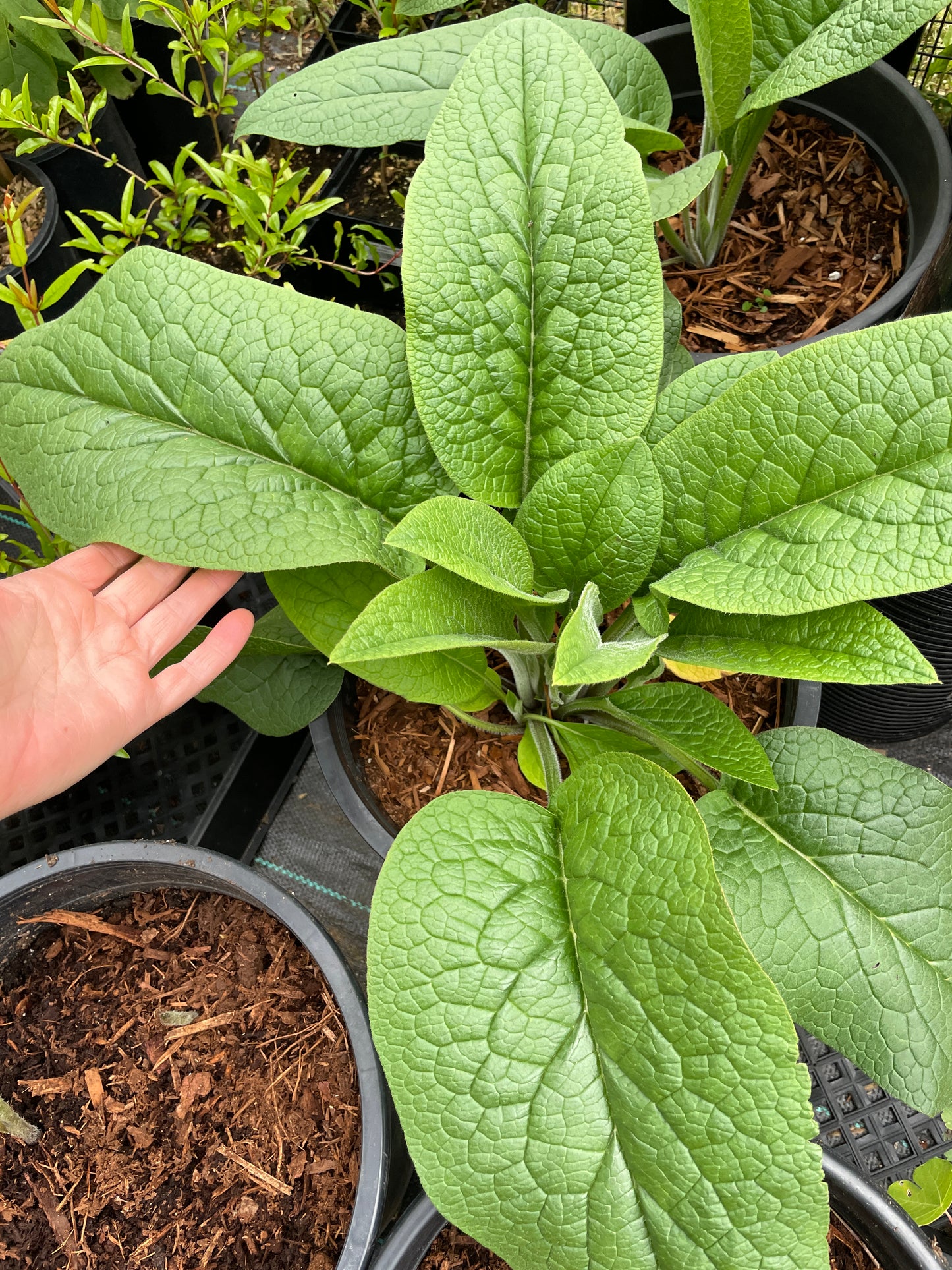
Comfrey is a vigorous, long-lived herbaceous perennial valued in gardens, orchards, and food forests for its abundant foliage, deep root system, pollinator-friendly flowers, and usefulness for building and recycling soil fertility. Once established, plants produce large amounts of leafy biomass that can be cut several times throughout the growing season and used as chop-and-drop mulch or added to compost.
Though *comfrey is not edible*, it develops a substantial, deep-reaching root system that can access water and nutrients from deeper soil layers than many shallow-rooted garden plants. These nutrients are incorporated into its fast-growing foliage and can be returned to the soil when the leaves are cut and used as mulch or compost. Comfrey foliage is particularly rich in potassium and decomposes readily, making it especially useful around fruit trees, berry bushes, and other productive plants.
Comfrey flowers are also highly attractive to bees and other pollinators. With its rapid regrowth, abundant biomass, deep roots, and long lifespan, comfrey makes an excellent support plant for gardens, permaculture systems, orchards, and food forests.
We offer two varieties of comfrey:
Common Comfrey
The traditional European comfrey species. Common comfrey, also called true comfrey or wild comfrey, produces viable seed and can spread both by seed and from pieces of root. This makes it a good choice where naturalizing is desirable, but it should be planted somewhere it can remain long term.
Scientific name: Symphytum officinale
Light requirements: Full sun to part shade
Full-grown size: 2-3.5' tall x 2-3' wide
Hardiness: Zone 3
Pollination: Self-fertile
Wildlife: Flowers are very attractive to bees.
Origin: Native to Europe and western Asia; long cultivated as a medicinal and fodder plant.
Noteworthy: Can self-seed. Excellent support plant for food gardens and food forests.
'Bocking 14' Comfrey
A selected clone of Russian comfrey developed for vigorous leaf production. Bocking 14 is sterile and does not spread by seed, making it particularly well suited to managed gardens, food forests and permaculture systems. It is propagated vegetatively from root cuttings or divisions. Like common comfrey, however, pieces of root left in the soil can develop into new plants so consider its placement.
Scientific name: Symphytum × uplandicum ‘Bocking 14’
Light requirements: Full sun to part shade
Full-grown size: 3-4' tall x 2-3' wide
Hardiness: Zone 3
Pollination: Will not produce viable seeds even if pollinated.
Wildlife: Flowers are very attractive to bees.
Origin: A clone of Russian comfrey selected in Bocking, Essex, England, by Lawrence D. Hills.
Noteworthy: Seeds are sterile so it does not spread as easily as common comfrey.
*Regarding edibility: Young comfrey leaves have traditionally been cooked as greens, and leaves have sometimes been used in teas or other preparations. However, comfrey (Symphytum spp.) contains pyrrolizidine alkaloids (PAs), compounds that can damage the liver. Because of this, Health Canada advises against ingesting comfrey and restricts comfrey-containing products intended for internal use. Comfrey is safe to use in food gardens, and in making soil and compost for food gardens, but we do not recommend ingesting the plant itself.
Share