

West Coast Plants
'Firecracker' Goji Berry
'Firecracker' Goji Berry
Couldn't load pickup availability
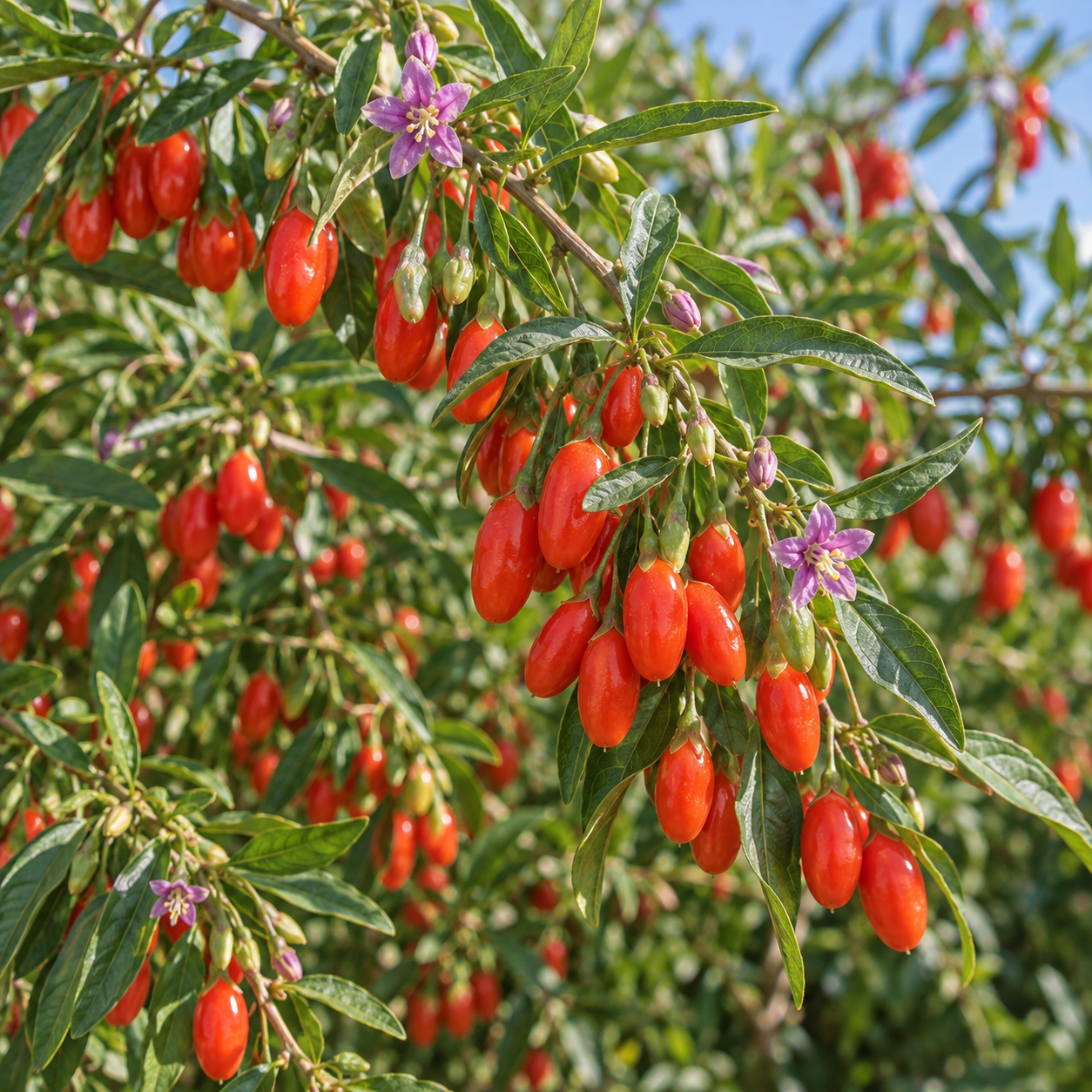
‘Firecracker’ is a cold-hardy, productive goji berry selected for its early and abundant crops of bright red-orange fruit. Goji berries are nutrient-dense fruits rich in carotenoids, particularly zeaxanthin, as well as vitamin C and other antioxidant compounds. The elongated berries have a mildly sweet, slightly tart flavour and can be eaten fresh or dried, frozen, or added to smoothies, baking and other dishes. Small purple flowers appear over an extended period, followed by successive crops of berries from summer into autumn.
Plants typically grow 4–6 ft tall and can be pruned or trained on a support to maintain a more compact, upright form. ‘Firecracker’ performs best in full sun and well-drained soil and is drought tolerant once established. Plants may sucker vigorously over time, making them useful in edible hedges and food forests where some spreading is acceptable, but they should be sited carefully as they can spread beyond their original planting area, forming expanding patches or dense thickets.
‘Firecracker’ is self-fertile, so only one plant is required for fruit production. Its combination of cold hardiness, early fruiting, heavy yields and an extended harvest season makes it particularly well suited to northern edible gardens.
Common names: Goji Berry, Wolfberry, Chinese Wolfberry, Matrimony Vine
Edible: Fruit
Harvest timing: Early for a goji; roughly mid-summer through autumn. Earlier than 'Dynamite.'
Scientific name: Lycium barbarum 'Firecracker'
Light requirements: Full sun
Full-grown size: 3-6' tall x 3-4' wide
Hardiness: Zone 4
Pollination: Self-fertile
Wildlife: Flowers attract bees and other pollinators, while ripe berries may be eaten by birds. Not deer resistant.
Origin: Species native to temperate Asia, particularly northern/central China.
Noteworthy: Cold hardiness, early fruiting, heavy yields of nutritious berries.
Share